Ten years after the 2016 edition in La Grave-La Meije we are delighted to announce that the Piolets d'Or are returning to the Oisans territory, this time into the heart of the Écrins National Park, namely to Saint Christophe-en-Oisans and La Bérarde in the Vénéon valley. This internationally lesser known valley (compared to Chamonix, Zermatt or Grindelwald), is a unique and wild historical basecamp for alpinism in the southern Alps, located just one hour drive from Grenoble.
Two years after severe floods heavily impacted the valley and in particular wiped out half of the La Bérarde village, the Piolets d'Or are joining a collective initiative to redevelop mountain activities in an innovative way in the higher Vénéon valley.
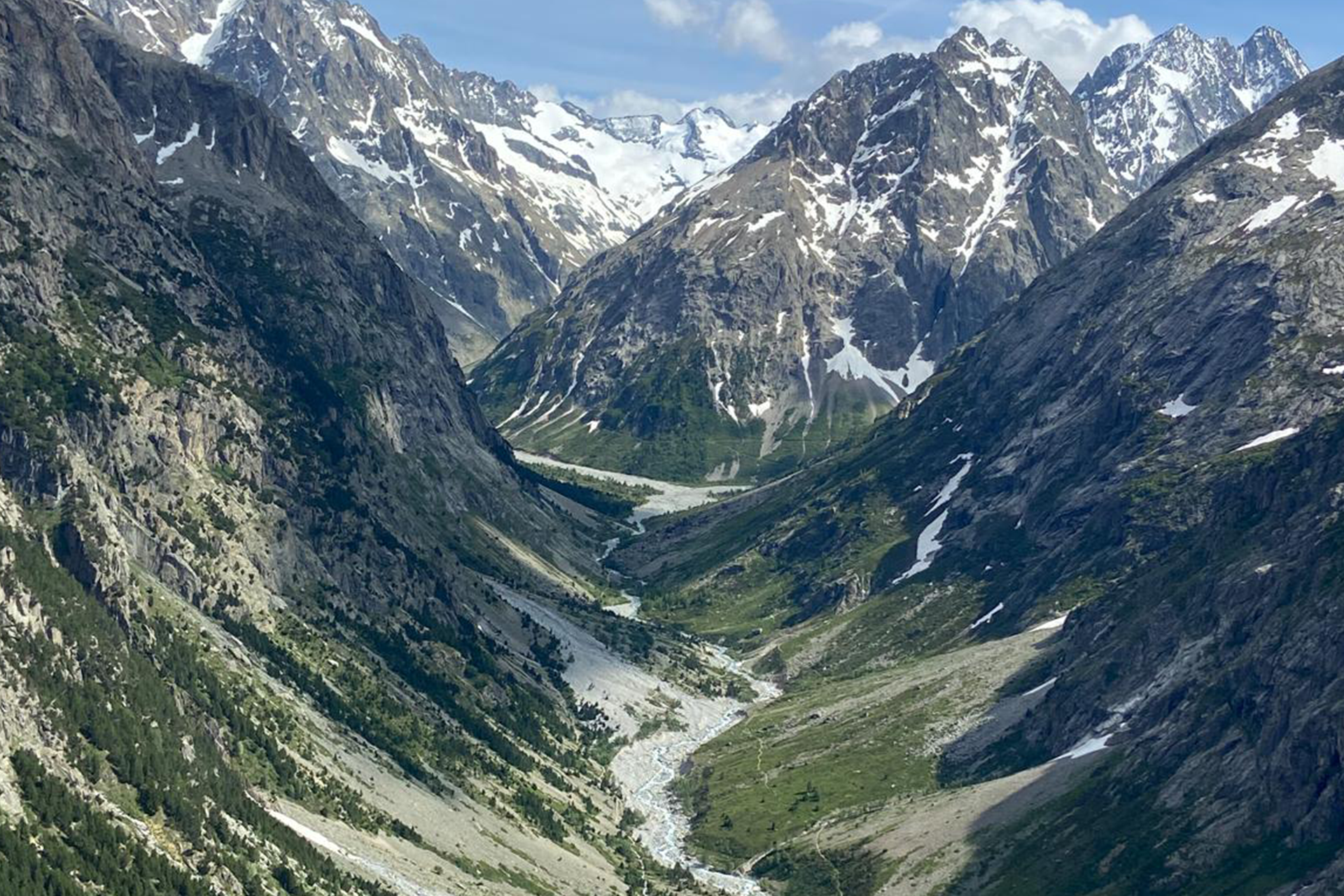
The Vénéon Valley, in the heart of the Oisans massif, is one of the wildest valleys in the Alps. Carved out by the Vénéon torrent, it stretches between steep-sided gorges, hanging valleys and dizzying peaks. Its landscapes are dominated by the majestic high peaks of the Écrins massif (the ‘queen’ Meije, the Barre des Écrins, the Ailefroide, the Bans, the Olan and the Muzelle, to name but a few of the main summits), which lend it a spectacular and unspoilt character.
Here, nature has remained largely untouched, boasting remarkable biodiversity and vast protected areas such as the Écrins National Park and the Lauvitel Strict Nature Reserve. The villages and hamlets clinging to the slopes, such as St Christophe, bear witness to a discreet human presence set against the immensity of the mountain environment. Its rugged terrain and unspoilt landscapes serve as a reminder of the power of the elements that have shaped the Alps. The Vénéon Valley thus embodies an authentic, wild and majestic mountain landscape, where nature reigns supreme.
For a long time – from its golden age in the 1850s–80s right up to the early 21st century – the valley was a ‘hotspot’ for lovers of mountaineering, hiking and the great outdoors. La Bérarde and the Haut Vénéon were also a major base for training in mountain activities: guide training prior to the formal establishment of the ENSA in the 1930s and 1940s, the FFCAM’s alpine centre, the UCPA centre and the Guides’ Office.
Since 2003, regarded as a turning point, this valley has been one of the areas in the French Alps where the impacts of global warming are most pronounced. The footpaths and mountain huts are particularly visible indicators of these changes. As a result, the iconic huts of La Pilatte and Le Châtelleret have been closed due to these impacts. The major event in June 2024, which caused considerable damage starting from the hamlet of La Bérarde and extending down to the bottom of the Vénéon Valley, received extensive media coverage. Today, it is clear that visitor numbers have been severely affected; they are significantly lower than their peak in the 1980s.
Paradoxically, this situation may present an opportunity for a fresh start! That, at any rate, is what we all hope for. Our vision is to showcase this exceptional natural and cultural heritage, to learn to live with risk, and to embark on an innovative and collaborative approach involving all the relevant stakeholders.